|
Farming in Lewiston: Sugar beets
to grasses, always an uphill trek
|
By Megan Sonderegger
April 28, 2006 | LEWISTON -- The lush green farmlands
and open grassy fields surrounding this city were
not produced naturally. Because of hardworking
farmers who spend every day adapting to their
difficult agricultural environment and modern
day changes, Lewiston has become the paradise
they create.
"They've had an uphill battle ever since agriculture
began in Lewiston," said Craig Smith, a soil specialist
at Utah State University.
|

AHHH:
Welcome rain drums on the farm fields of
Lewiston. / Photo by Megan Sonderegger |
Gordon Barlow, who has lived and worked on his farm
for 55 years, remembers working the fields when he was
young. He feels the biggest change made in agriculture
was the shift from sugar beets to dairy products and
grasses. Sugar beets used to be the economic boom in
Lewiston and most farmers spent year-round efforts to
produce these crops, he said.
"Sugar beets were a very labor intensive crop. We
started them first thing in the spring, and they were
the last thing harvested in the fall. They took a lot
of manual labor," he said.
During flooding seasons Barlow and his brothers would
have to wait until late at night when the ground was
frozen in order to farm the land. Sugar beets demanded
a lot of attention and farmers would have to manually
thin the plants in order for them to grow to their proper
size.
"We had to go through three times a year and weed
them. Imagine weeding your garden for acres and acres,"
he said with a laugh.
Smith said sugar beet production ended because other
areas had more resources and greater economies and because
sugar beets grew better in different environments.
"Lewiston had its own sugar factory. It was the big
crop of the past and was probably the biggest shift,"
Smith said.
Although Barlow and Smith agree sugar beets were the
greatest agricultural shift, Brent Glover, another local
farmer, said he feels the biggest shift in agriculture
has been technological advancements in farming. He said
although these advancements allow for easier workloads
they deplete farmers' incomes and can be wearying financially.
"It makes it a lot easier but we have to own a lot
more ground to live on what we used to," Glover said.
He said most farmers have to take second jobs in order
to survive because crop prices are low and farming equipment
is extremely high. Farming in the valley is also challenging
because of the difficult soil, the high water table
and the mixed seasons, Glover added.
"It's hard to make it on a farm nowadays," he said.
Smith said the city's water table has always been
extremely high and early Lewiston farmers used to dig
drains so water would flow from the soil into drains
which eventually led to the river. Modern technology
has created artificial drainage systems which help the
water table go down slightly, but most of the artificial
drains were installed 40-50 years ago and may be in
fairly bad working condition, Smith added.
"Last year there was a lot of alfalfa that died out
because it basically drowned. [Lewiston has] had a lot
of flooding and a lot of drought and the two extremes
are difficult," Smith said.
Barlow said most farmers have not been able to start
planting this year because of flooded soil. He said
late seasons have a huge effect on crops such as barley,
and many crops die because they can't handle the heat
of summer while in growth.
"You work with it as it comes, and you do your best,"
He said.
Barlow said the ground is made up of clay and sand-based
soils which present another problem to farmers. Clay
soil floods easily and will become clod-like if not
worked in the proper season, whereas sandy soil has
to be worked in the opposite season while adding large
amounts of water to moisten the soil enough to plant,
he said.
"Even in the sandy soils you can dig down and find
clay," Barlow said.
Janice Kotuby-Amacher, director of the soil testing
lab at USU, said farmers can not afford to replace their
topsoil with brought-in organic soils, so most have
to work with what they have. She said productive types
of soil depend on the crop grown but clay is extremely
hard to farm.
"Clay soils are the hardest to work with for farmers,"
Kotuby-Amacher said.
Despite the enormous amounts of farming challenges
Smith said the farmers in Lewiston are extremely capable
and are willing to be flexible in their capabilities,
and progressive in their willingness to try new ideas.
"They have a lot to balance out there, but they have
a knowledge base from experience and they're willing
and open to try new things. Maybe the next big shift
is on the horizon." Smith said.
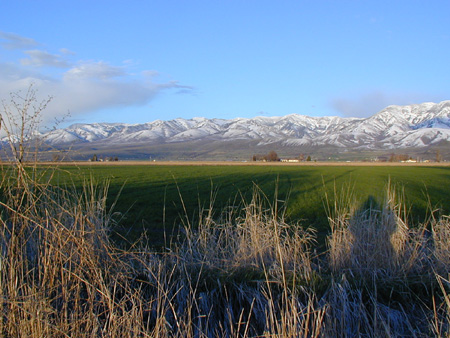
The farm fields near Lewiston beckon. / Photo by
Megan Sonderegger
NW
MS |