|
Nibley-owned barn packs a lot
of history in its walls
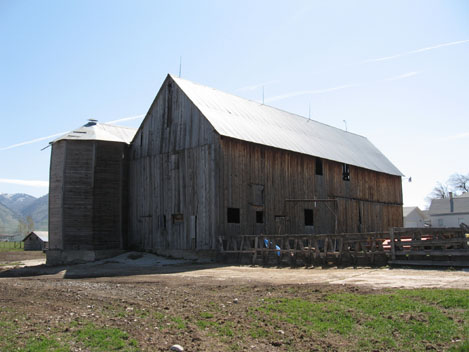
The historic Nibley barn. / Photo
by Shannon K. Johnson
By Shannon K. Johnson
April 23, 2007 | It doesn't look like much with its
gray and auburn boards that have warped as the barn
has stood for more than 100 years.
The barn looks almost lopsided, but its vast walls
still slide on its rusty tracks.
It has become a landmark, and though the lands look
almost empty now with only a few cattle wandering in
a back field, because of its history the barn was recently
purchased by the city of Nibley.
When it was first built, the barn was a small lean-to.
The wall that now faces the inside of the barn is has
a trough on opposite side. Instead of solid plank walls,
this wall has slots that are designed for the cattle
to slip their heads through.
Each slot, or stanch, is made up of two boards: one
that is anchored and the second that hinges on a bolt.
This single, rough-cut board is the hinged upright that
locks them into place.
Dee Gibbons was the most recent owner of the barn
and its land. He purchased it in 1981.
As a teenager, he came to work on the farm. Back in
those days it was a dairy farm. So in that old lean-to
cows would be herded in carefully, screened for infection
and milked.
In those days the screening meant milking each teat
over a screen that sat atop a small cup and if any thing
congealed on the screen it meant there was an infection,
said Gibbons.
Running a dairy farm was a more intense process then
it is today. Not only are the cows milked once or twice
a day, the grain that feeds the cows is grown on the
surrounding land. Chickens, pigs and horses are also
raised on the farm.
When the barn was fully functioning, the farmer would
grow hay for the cattle. Hay grows quickly and needs
to be harvested a few times a season. To harvest the
hay a cutter would cut the tall, leafy blades and leave
them lying in the field allowing the hay to cure.
Then two men working with pitchforks would walk side
by side and fold the hay into rows and then back again
making piles.
Finally a wagon would be driven between the rows and
those same men would stab long pitchforks into the hay
and toss it over their heads.
Gibbons, as a teenager, would stomp the hay into the
wagon.
"You can carry more hay that way. I'd use to spread
the hay around with my pitchfork, but every once in
a while I'd fall in a hole."
The wagon would then pull up to the side of the barn
and a pulley would slide out on a track and lower a
hinged device with interlocking curved hooks, it is
almost like salad tongs, and the fork would grasps the
hay and pull it up out of the wagon.
It would then slide the fork with the hay along a
track that runs along the roof of the barn. A man inside
would pull a small trip rope and the fork would open
and dump the hay in a pile in the center of the barn.
After having spread out this hay the cycle would continue
until the hay reach almost two storied completely filling
the large room.
Most of the barn was devoted to storage for the hay
with only a small coral for calves and the area that
was once a lean to for the milking.
The final part of the barn was also used for storage
it is a he eight-sided grain silo the entire structure
has never leaked.
A silo is a storage center for corn that has been
run through a chopper and is essentially blown into
the wooden tower.
The grain is then smoothed so the silo can fill evenly
where the corn is left inside the corn ferments.
"Essentially the silo is holding a tower of water,"
said Gibbons.
The two by fours that make up the walls of the silo
are rough cut and lay so they are only two inches tall.
To open the silo a series of doors that lock into
place run up one wall of the silo. To open the door
you have push the door on its wide looped hinges in.
The rusty hinges loop out and they serve as a ladder
to allow a worker to climb to the highest window and
drop the feed to a wheel barrow down below.
Nibley did not just purchase a barn though it bought
the surrounding land and a few of the neighboring buildings.
One building was a tractor shed constructed via the
simple process of nailing a rough frame together.
"This is the way you make a building when you have
nothing," said Gibbons.
Four posts make up the corners with three boards connecting
three of the four walls, a second floor is made by the
simply process of laying them on top of the top boards
which run along all four walls.
The building has the same gray wood that the barn
does and the walls are simply rough cut planks nailed
directly to a frame.
Right next to the tractor shed is a more domestic
looking structure it is an old house that had been moved
from Millville.
Years ago it was converted into a shop for farm equipment
repair.
The house is small with what was once friendly plaster
walls with insulation and even glass windows, but it
has not been lived in for years.
Though the historic barns value is obvious it having
been featured in a book about barns, the city of Nibley
does not really know what they are going to do with
the old structure now.
Making the area a park or a 4-H club headquarters are
some of the ideas discussed at council meetings, but
now the barn is getting cleaned by the city.
MS
MS
|