Unauthorized
trails lead to problems in Millville Canyon
|
By
Amanda Mears
December 10, 2007 | The number of people who
own off-highway vehicles (OHV) has exploded in
recent years. In 2000, it reached almost 36 million,
according to the Bear River Watershed Council
(BRWC) Web page.
However, the problems caused by off-highway
vehicles, including dirt bikes, ATVs and other
motor vehicles such as dune buggies, on unauthorized
routes could be a problem for Millville residents.
Dan Miller, executive director for the BRWC,
said there are two big problems in the Millville
Canyon caused by the use of unauthorized routes,
including water quality and wildlife habitat.
"Elk need a certain amount of space," Miller
said. He said the wildlife has been seriously
impacted at the top of the canyon where there
are almost five miles of unauthorized routes within
one square mile.
One way these trails impact the wildlife, said
Miller, is through noxious weed dispersal. Tires
from OHV's can carry the seed everywhere and since
wildlife don't eat it, it impacts their grazing.
Water quality is another problem that can affect
Millville. |
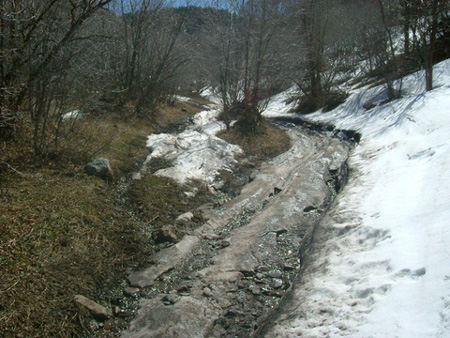
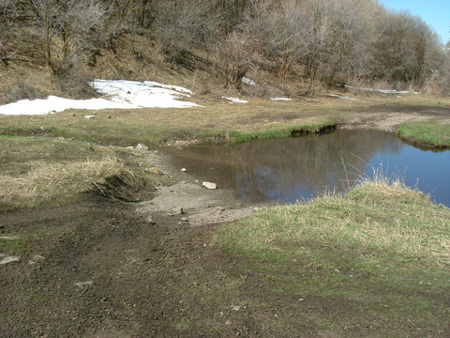
EROSION AND DAMAGE: Trails
show deterioration in Millville Canyon. /
Photos courtesy of Dan Miller
|
"In some places," Miller said, "the water is running
down the road and all the erosion goes into the stream."
Logan resident John Borg, a multiple-use vehicle advocate,
said he attributes the problems with some OHV users
in Millville Canyon going off the designated roads to
two factors.
"Some of this may be because the Millville Canyon
Road is a little rugged in places and there are bypass
routes which have either been created, or follow an
old road location," said Borg. "But I think most of
it is due to OHV users not understanding how their use
is limited to designated routes, or they are seeking
more opportunities than those that currently exist."
Borg said he has ridden mountain bikes on the Logan
Ranger District since the early 1980s and has hiked,
skied, fished, hunted, and camped on the Logan Ranger
District over the course of his life. However, Borg
said he rarely rides in Millville Canyon because of
the limited opportunities and usually accesses the Logan
RD from other trailheads.
"I ride my motorcycle on the Millville and South Fork
Roads once a year or so just to see how things are looking
and if there's any need to clear trees that have fallen
on the roads," Borg said.
In order to track and correct problems caused by improper
use of motorized vehicles, BRWC's Motorized Use Date
Project (MUD) was created. Miller said MUD volunteers
walk every authorized route photographing and documenting
the impacts of motorized vehicle use.
Through this type of data collecting, the BRWC has
found that approximately 25 percent of the routes in
the Logan Ranger District are unauthorized.
The point in all of this, said Miller, is to eventually
restore the trails and improve habitat on unauthorized
routes.
"We are not closing roads," Miller said, "but we are
building barriers."
The BRWC works closely with the forest service to
stop the use of unauthorized trails. Miller said they
notify the Forest Service when they find trouble areas,
and the Forest Service can then place warning signs
around the area. Unfortunately, Miller said the signs
are often defaced soon after they are put up.
"Mostly it's not effective because signs get shot
at or torn down,' Miller said.
Rather than closing roads and putting up signs, Miller
said they are trying to work with the environment to
naturally deter people away from unauthorized routes.
Recently, BRWC volunteers along with the Wasatch Outlaw
Wheelers , a club of four-wheel drive enthusiasts, teamed
up in order to put up restoration barriers and clean
up trash around the area.
The road to restoring Millville Canyon has been a
rough one, but thanks to collaborative efforts, Miller
said the canyon has come a long way. Miller said when
he first approached the Wasatch-Cache National Forest
asking that Millville Canyon be considered top priority,
they said it was not possible. However, Miller said
he was not willing to give up that easily.
"I told them we had a diverse interest group willing
to work all all we needed was a 'yes' from the Forest
Service to make it a priority," Miller said.
In order to raise the money needed for the project,
Miller said they have relied heavily on donations, grants
and volunteer work.
Miller said organizations such as BioWest and the
Utah Four Wheel Drive Association gave money, time and
even a hydrologist in order to move the project forward.
Miller said that Millville was such a high priority
for the BRWC because of the certain problems it has
been facing.
"We're targeting Millville because it has a serious
issue and we want to use it as an example of what we
can do for Providence and Left Hand Fork," Miller said.
Miller said next May, Utah Backcountry volunteers
will take a crew of 15 people up the canyon camp for
a three-day work weekend to continue restoration. Miller
said a dutch oven dinner will be provided by Camp Chef
( http://www.campchef.com) for volunteers that attend.
"We've got our foot in there on restoration projects,"
Miller said. "It's a good place to keep working."
From the perspective of a motorized vehicle user,
Borg said he thinks all the impacts can be managed,
but it will a collaborative effort to make both the
BRWC and the public happy.
"Since this area is already limited to designated
routes," Borg said, "it's a matter of route selection,
route management, design and maintenance to minimize
impact while providing a travel system that meets the
public's need."
Borg said his desire is to see various, diverse uses,
not just recreation done in a sustainable way.
"I'd hope to see better compliance with the route
designations and an increased enforcement presence,"
Borg said. "I also feel that some improvements to the
travel system are needed to better meet OHV users' needs
while minimizing impacts. A travel system that better
meets the OHV users' needs could reduce the "do it yourself"
creation of trails and help direct use to routes that
manage and minimize the impacts."
For more information on upcoming projects visit http://www.utahbackcountry.com
or http://www.brwcouncil.org.
NW
MS |