|
By Davis Archibald
December 11, 2007 | Mark Gibbons has been farming
all of his life, just like his father and grandfather
before him.
"I can't think of anything I enjoy more
than running the ground," Gibbons said.
But Gibbons is confronting issues that did not
challenge his father. Urbanization, immigration
and environmental pressures are just a few problems
dairy farmers in Cache County are facing.
According to Dr. Allen Young, dairy specialist
at Utah State University, the future looks "challenging"
for dairy farmers in Cache County.
Historically Cache County has been the largest
dairy county in Utah, but last year it was overtaken
by Millard County, according to the 2006 report
from the Dairy Herd Information Association.
According to Young, the change is due to low
milk prices, the rising cost of fuel and urbanization.
"Urbanization has been the thing that has
really pushed them over the edge," Young
said. Young said it's hard to expand because of
urbanization and the rising costs of land prices.
And according to Young, expansion is key to
surviving in the modern dairy market.
"We should have the right to farm, but
we've got to use our head," Gibbons said.
Fortunately, Gibbons and his family have been
able to expand their farm over the years. When
his father was actively farming they had 40 cows.
Now Gibbons and his brothers have more than 500
and plan on expanding to 650 within the next year.
Gibbons also plans to install a methane digester
to help produce more energy and curb costs.
Along with urbanization comes a loss of connection
with food and land, said Young. In fact, according
to Young, the milk you buy at the store does not
necessarily come from Cache County or even Utah.
"We might lose a war militarily, but as
soon as we start depending on other countries
for food, we're screwed," Gibbons said.
|
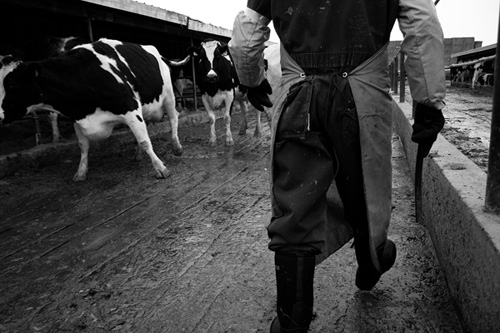
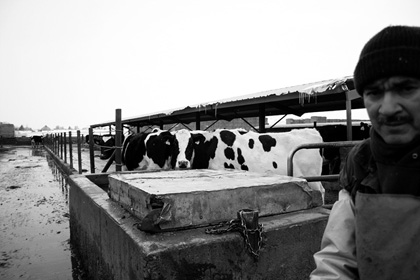
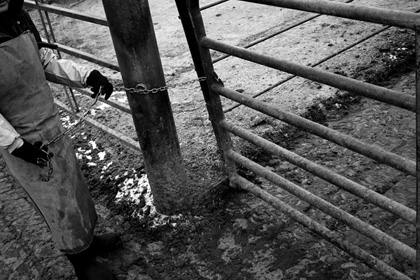 Mario Rodriguez opens up the gates to move the
cows to the milking barn Dec. 15, 2007.
Mario Rodriguez opens up the gates to move the
cows to the milking barn Dec. 15, 2007.
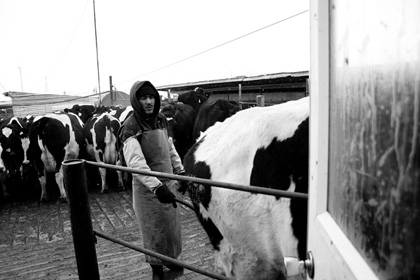
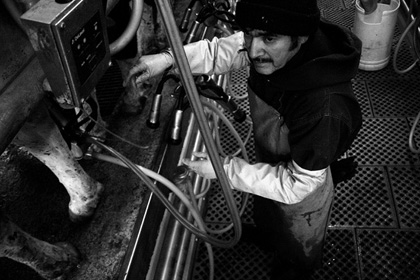
Rodriguez prods the cows into the barn, above,
and milks them, below.
|