| Ordinary
man, genocide survivor encourages youth to shape future
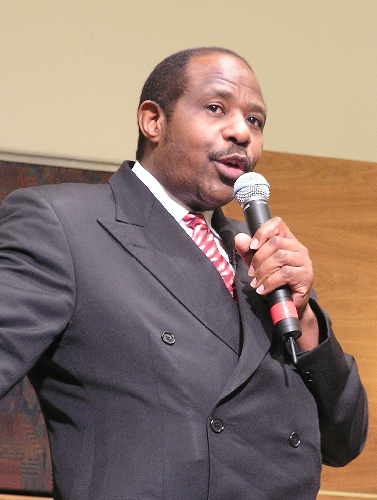
"AMAZING":
Paul Rusesabagina addresses USU students Thursday. /
Photos by Brianna Mortenson
By Camille Blake
February 3, 2006 | Please welcome
Paul Rusesabagina. One, three, eight and then everyone
stood Thursday afternoon to applaud the man who helped
save more than 1,200 people from genocide in Rwanda.
"He was amazing," Christy Moysh said, a junior
in family, consumer and human development. "He
could tell his story without emotion or little emotion,
in front of a different culture. That says a lot about
who he is."
On April 6, 1994 the Hutu militia started killing Tutsi
and some Hutu citizens. Rusesabagina said he was eating
dinner with his brother Thomas and Thomas' wife at the
Belgium owned Mille Collines Hotel, when his wife called
distressed about the missiles she had heard. He and
his brother rushed home, never to see one another again,
Rusesabagina said.
"I never understood why people came to my house,
why they trusted me," he said.
For three days, 26 strangers stayed with him and his
family in their home. Rusesabagina said soldiers came
for him because he had the keys to the cellars at the
hotel. The captain told him he could take everyone with
him to the hotel.
All along the way they passed dead bodies; some decapitated,
some with bellies cut open and others mutilated, Rusesabagina
said.
The threat of being killed by the militia was always
present. Rusesabagina said he had to use many favors
to get generals to pull the soldiers out of the hotel.
The militia then created a roadblock so that no more
refugees could enter and none could escape, Rusesabagina
said.
The electricity was cut off, the generators broke down
and all the phone lines were cut. Refugees were getting
water out of the swimming pool and fire for light. Rusesabagina
said he would go sit by the pool each night and slowly
watch the water level fall.
However, one fax line was still intact. That was their
life line, he said. He faxed every international contact
he knew. Still, Rusesabagina said he was sure they were
all going to be killed and it was up to each individual
how they chose to die.
May 2, 1994 brought relief; Rusesabagina said U.N. trucks
arrived with a list of names of those to be evacuated.
He was to be evacuated but some would still be left
behind.
"That night, I made the toughest decision of my
life," Rusesabagina said. "I told my family
that I was not going to leave with them."
He said he couldn’t live with the fact that people
would be killed, left behind at the hotel, while he
lived. While he helped load his family into the trucks,
the Hutu media was reading the list of names over the
radio, Rusesabagina said. Roadblocks were set up to
stop the trucks and kill the "Mille Collines cockroaches."
The trucks returned with injured refugees and one dead
U.N. soldier. Rusesabagina said his wife was bleeding
and covered with others' blood. She gave him her wedding
ring, went to her room and stayed there for four days,
he said.
May 26, 27 and 28 refugees were evacuated and Rusesabagina
said he still wished to stay behind for the same reasons.
"Five hundred meters away people were being killed
in a church," Rusesabagina said. He was sure the
hotel was going to be next. He said he begged for soldiers
from the mayor of Kigali for protection, but the mayor
turned his back and said there were no soldiers to send.
Finally, Rusesabagina said he was able to get General
Bizimungu to provide safe evacuation for his family
and the remaining refugees. He said he did not go to
Tanzania like the movie depicts, but he is raising his
brother’s daughters.
Talking about the corruption of dictatorship in Africa,
Rusesabagina said, "Behind every African dictatorship
is a western superpower." He told students to tell
their elected leaders to send help to these countries
where genocide is occurring. The youth need to shape
their future.
"The basic need in life, to make men and women,
is education," he said.
If there was more education, these wars would not be
happening. No media is covering the wars in Africa,
Rusesabagina said.
"When are we going to put action to our words?"
he said.
Since he left to live in Belgium in 1996, another war
has broken out in the Congo with four million killed,
Rusesabagina said.

HW
HW
|


