|
Irving Wasserman's fascinatin'
rhythm of life: The man behind the festival
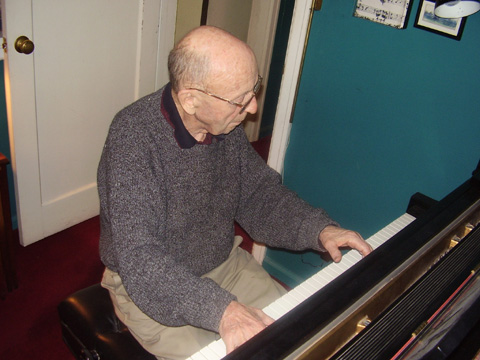
Irving Wasserman. / Photo by Jen Pulham
By Jen Pulham
February 14, 2006 | World War I. One family flees
the Russians across the Alps, over the Carpathian Mountains,
through Czechoslovakia, and into Vienna, Austria, where
Irving Wassermann, then a toddler, starts his lifelong
education in music.
Wassermann, now a 91-year-old resident of Logan, started
taking piano lessons when he was 5. The most impressive
piano instructor of his youth was Professor Mierski.
But Mierksi's lessons were more on life than music.
"I didn't learn one thing from him technically," Wassermann
said. "I learned from him to love music. I learned from
him to love literature. This man made me read just by
talking to me."
Wassermann loved him like a father, but that's not
unusual for Wassermann. He considers many of his acquaintances
as good as family, if not closer.
Wassermann has "adopted children" or "adopted grandchildren"
scattered across the globe, from Paris, to Nigeria to
China. Their pictures or letters adorn the walls and
tables of his basement music studio.
According to him, "I love them at least as well as
my own children." Some of his "grandchildren" are neighbors.
Others are former students. Many are not related, but
they all call him "grandpa."
At 12 years old, Wassermann wanted to become an engineer,
like his uncle. Instead he continued secondary schooling,
learning Latin, Greek, French, Polish, and Ruthanian.
In 1937, to pacify his father he attained his law diploma
from the University of Krakow. But this was not his
dream. "I wanted to be a lawyer as much as I wanted
to be the Pope," he joked.
Wassermann continued to play the piano, but his ambition
was not to play, either, nor to engineer, nor to practice
law. He wanted to teach. "I always loved teaching ten
times better than performing," he said. "I never dreamt
of being a concert performer, I always wanted to teach."
In 1938 he crossed the Atlantic Ocean and began life
in New York City. But for Wassermann, life was not exactly
a walk in Central Park. "I had no money," he said. "Little
by little I sort of began to make a living. You can
call it a living because I didn't die."
He began to play with a New York orchestra. A week
before rehearsal, Wassermann woke up with "fingers like
frankfurters." He could not play! The hospital was not
able to give him any answers, so when a friend suggested
that his big fingers could be the humidity, and that
he should move to Utah, Wassermann was willing to give
it a try.
His family, however, remained in Europe, very much
in harm's way. They were Jews, and as the Holocaust
began, something had to be done. His mother was able
to escape to America and joined her son in Utah in 1946.
His brother and sister, however, were killed by Nazis.
Wassermann's dream was realized in 1955: he became
a teacher at USU. During his years of teaching, he also
served as department head and director of the piano
program. It was during this time that he introduced
the music therapy program at USU.
In the 70s, he started to plan the Music West Festival.
"My idea was to have a music festival because I wanted
our students to learn about music," Wassermann said.
When he introduced the idea to his colleagues, he said
they thought he was nuts. After four years of discussing,
planning, and persuading, the festival began.
Now in its 26th year, the Wassermann festival revolves
around performances by guest musicians, particularly
pianists. They also hold lectures and workshops for
those interested. It has come a long way since instituted
by Wassermann.
Wassermann's purpose for having the festival was to
teach students to learn to play with other musicians.
"I wanted the pianists to play with violinists, the
violinists to play with vocalists," Wassermann said.
"The only way to learn is by playing with somebody."
When he retired, the festival changed hands and those
hands, in turn, changed the festival. It became a spring
festival deigned mostly for pianists, rather than all
musicians. "I'm just happy they have it," he said. "I
wish they'd make it more along the lines I envisioned.
It should be in the summer."
Wassermann still tries to attend the festival every
year, but he doesn't play the piano very much anymore.
"I've forgotten how to move my fingers," he said. But
as he posed for a picture, the old pianist's hands came
to life as he picked out the gentle melodies of Chopin's
"Nocturne", adding in his own improvisation here and
there.
Wassermann lives in Logan with his wife, Mary, and
they eagerly await news or visits from their children
and grandchildren, even those "adopted."
MS
MS |


