|
Sun River Farm in Mendon offers
fresh organic produce
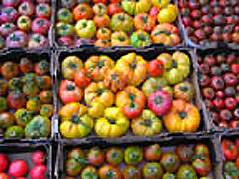
BRIGHT DISPLAY:
Some of the produce at Sun River Farm. / Photo by
M. Kathryn Hanberg
By M. Kathryn Hanberg
February 4, 2008 | MENDON -- The year 1998 involved
a life-changing event for James Haggerty. He had been
hit by a car, and because of the extent of his injuries
took a year off from his job. It was during this year
he chose to make some changes.
Up to the day of the accident, he ran Sun River Organics
in Salt Lake City, but as he said, "If you don't get
up and love what you do, you might as well get a new
job." It was because of this perspective Haggerty chose
to use the money from his settlement to purchase his
own land for an organic farm.
After the purchase of 4.6 acres in Elwood, Utah, Haggerty's
wife chose to attend Utah State University. Due to the
daily commute from Elwood to Logan, the Haggerty family
bought a home in Mendon. This is where the second Sun
River Farm was formed. A 1.75 acre field was purchased,
bringing the total farm acreage to 6.35 acres. This
amount has been enough to sustain Sun River Farm for
seven years.
At the time Sun River Farm formed in Utah, there was
only one other CSA -- community supported agriculture
-- in Utah.
The CSA is a way to build ties and networking systems
between local farmers and local consumers. It is a system
to "steal each other's ideas as a way to constantly
increase your learning curves," Haggerty said.
Though Sun River Farm started by being a vendor at
the local farmers market, it has now grown to selling
60 shares per year. This is about 100 families in Salt
Lake City and Logan combined. A share is a single payment
at the beginning of the year to receive weekly vegetables
during the season. This adds up to 18 weeks of delivery.
The season is the second week of June to the third week
of October.
Shares are sold as a half share for $200 or a whole
share for $400. The vegetables average out to be about
five items per share per week.
Though currently the items delivered each week are
predominately up to the company, Sun River Farm is working
to revise a plan to provide more customization. This
will allow the customer to choose half of the items
while the company chooses the other half.
Sun River Farm's delivery is so dependable that in
the seven years of business, there has only been one
unsuccessful delivery.
Being a CSA farm can be a challenge from year to year.
Because of this, shares are paid prior to the growing
season. Sun River Farm grows 40 different vegetables,
and hundreds of varieties. They grow over 100 types
of tomatoes. The farm is "extremely diverse because
I love it," Haggerty said.
There are many benefits to eating organic and locally
grown food. One benefit is the food miles. This is the
number of miles the food traveled from the field to
your plate. Food bought in grocery stores is often shipped
from across the country, whereas the farthest Sun River
Farm produce is shipped is 90 minutes south. This is
mutually beneficial. It secures consumers' access to
the produce each week, eliminates the middleman and
provides the freshest produce you can find, Haggerty
said.
Another benefit is the impact on the environment.
By rotating crops and tilling thousands of pounds of
compost into the soil per year, the soil can build up
rather than erode away. This also reduces the amount
of harmful insects, which reduces the amount of pesticides
used.
"Like a lion that goes after the weakest in the herd,
the insects generally go after the weakest plants,"
Haggerty said.
There are many other ways to care for the crop as
well. Along with those mentioned above, having crop
diversity, using a floating row cover and only using
organic pesticides can not only reduce the amount of
insects, but the pesticide residue found on the plants
as well, Haggerty said.
Floating row covers can be used for more than insect
protection. They can also be used to reduce frost. This
increases the crop season. A floating row cover is a
cover that is draped over the crop that can allow water,
air and light in while keeping insects and cold out.
Sun River Farm is anxious to learn of new ideas. If
the demand is great enough, there may be an option for
a student share which would cover early September through
late October. This would provide some of the best crops
of the season.
There is also the possibility to buy any extra produce
at the drop-off sight during season. That takes place
every Wednesday from 4 to 6:30 p.m. at Sweet Peas Market
in Logan. If you are interested in buying a share or
providing suggestions, visit Sun
River Farm's Web site or e-mail Haggerty at sunriverfarm@yahoo.com.
NW
MS |


