| A
legacy of peace and tolerance
• Candlelight vigil honors Dr. Martin Luther
King Jr.
"When I speak of love, I am speaking of that force
which all the great religions have seen as the supreme
unifying principle of life. Love is the key that unlocks
the door which leads to ultimate reality."
--Dr. Martin Luther King Jr.
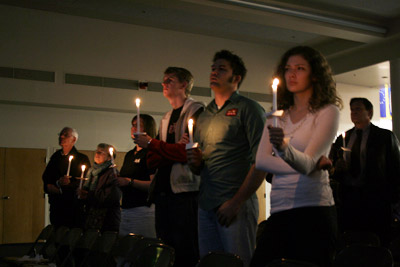
LETTING LIGHT SHINE:
Community members hold candles in the vigil for Martin
Luther King. / Photo by Gideon Oakes
By Gideon Oakes
January 18, 2007 | Nearly 100 people gathered in the
Sunburst Lounge of the Taggart Student Center Tuesday
night to pay tribute to arguably the most prolific civil
rights leader of the last century, Dr. Martin Luther
King, Jr.
The program, presented by the USU Black Student Union,
began at 6 p.m., the approximate time King was shot
to death in 1968.
King's legacy was the subject of the program's keynote
speech by Dr. David E. Dixon, an assistant professor
at Saint Joseph's College and co-editor of Rhetoric,
Religion, and the Civil Rights Movement, a commentary
on the connection of religion and the motives of civil
rights leaders.
Dixon began by giving what he called an "impressionistic
take" on King's religious ideal as an ordained Baptist
minister that guided his hand in crafting the civil
rights movement.
"His resolve, I would argue, came from his religious
belief and his religious charge of responsibility that
very few other people have been able to take on," Dixon
said.
Dixon also discussed his research for his book and
said that it surprised him to find out that a nearly
equal number of whites were killed alongside blacks
during the civil rights movement.
"It didn't matter whether you were black or white in
terms of whether you were killed as one of these progressive
ministers," Dixon said. "People killed you irrespective
of race."
He also noted that veterans were mistreated and killed
as frequently as pacifists who hadn't served in World
War II.
Dixon believes that King's work and legacy lives on
in the words and actions of those who he touched.
"Think of all the people Reverend King brought together,
whether in political coalitions or in religious dialogue.
What do John F. Kennedy, Lyndon Banes Johnson, Malcolm
X, Ralph D. Abernathy, Mahatma Gandhi, and others have
in common, beyond their work with Reverend King? Very
little, I would argue."
Dixon expressed his hope for the continuation of the
progress made in the civil rights movement.
"None of our beautiful ideas will be useful for long
if we do not educate our children. The legacy ends if
we have no next generation to replace us," Dixon said.
Moises Diaz, director of Multicultural Student Services
at USU, echoed Dixon's sentiment.
"The things that we do in the next years will have
implications for many years to come. It's all about
the choices that many individuals make; and collectively,
we can move forward in a more positive way," Diaz said.
The program ended with the lighting of candles, in
honor of the first candlelight vigil held at King's
Ebenezer Baptist Church on April 4, 1968, the night
he was assassinated.
"Lighting a candle tonight is symbolic. As one individual
flame lights another, which in turn lights another,
our flames together reach upward and fill the room,
much as Dr. King's dream filled the people," said Jennifer
Gowon, president of the USU Black Student Union.
Accompanying the candle lighting was a slideshow of
King's life and times to the tune of Marvin Gaye's song,
"What's Goin' On."
Mother, mother
There's too many of you crying
Brother, brother, brother
There's far too many of you dying
You know we've got to find a way
To bring some lovin' here today - Ya
Father, father
We don't need to escalate
You see, war is not the answer
For only love can conquer hate
You know we've got to find a way
To bring some lovin' here today
Picket lines and picket signs
Don't punish me with brutality
Talk to me, so you can see
Oh, what's going on
What's going on
Ya, what's going on
Ah, what's going on
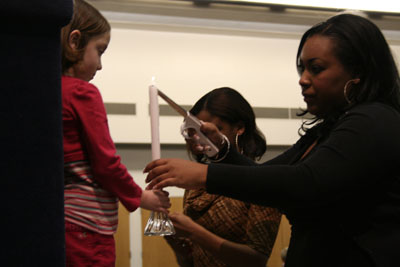
Jennifer Gowon, president of the USU Black Student
Union, lights one of the six candles used to light the
audience's candles. / Photo by Gideon Oakes
BS
BS
|


