| Students
get bitten repeatedly to link snakes' aggression, resistance
to toxin
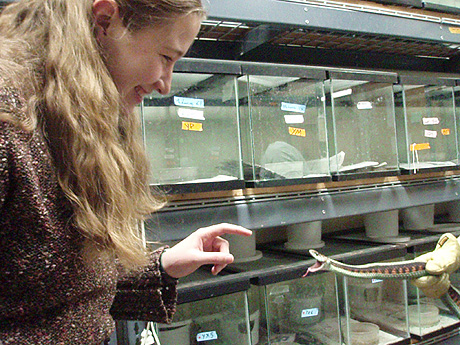
SHE SAYS IT DOESN'T HURT:
Ashley Wilkinson, a junior majoring in biology, prepares
for a bite from a T. sirtalis. An experiment
conducted by Wilkinson and fellow student Amanda Mortensen
revealed a correlation between the aggression of garter
snakes and their resistance to tetrodotoxin. / Photo
by Jen Beasley
By Jen Beasley
January 22, 2007 | Amanda Mortensen and Ashley Wilkinson
are snakebit. But the Utah State University juniors
aren't down on their luck; they're just doing research.
While assisting in gathering garter snakes for a graduate
student's research in Monterey County, Calif., the biology
students observed that some of the captured snakes were
quite aggressive. They began a project investigating
whether there was a relationship between the snakes'
resistance to tetrodotoxin -- a deadly neurotoxin found
in the skin of the rough-skinned newt, a food source
for some garter snakes -- and the aggression of the
snake.
"We found this really, really amazing correlation
between aggression and resistance," Mortensen said.
And how does one determine if a snake is aggressive?
The old fashioned way: you stick your finger in front
of it and see if it bites you.
"It doesn't hurt," Mortensen said. "It just feels
like Velcro. Their teeth don't actually go through the
skin."
The study, which was conducted using three species
of neonate garter snakes, revealed that the more resistant
a snake was to tetrodotoxin, the more aggressively it
behaved. Snakes of the species T. elegans showed
little resistance to the toxin, and generally fled when
confronted. But individuals of the species T. atratus
and T. sirtalis showed a greater resistance.
In some 60-second trials the most resistant snakes struck
as many as 70 times, Mortensen said.
The experiment was conducted in two stages. Because
resistance to tetrodotoxin varies greatly between individuals
and localities, each snake was put through a trial to
determine its resistance. The women timed each snake
in a trial crawl down a racetrack, and then injected
it with a dose of the neurotoxin, and ran it through
the course again to see how much it slowed down. They
continued injecting the snake with the toxin until it
was slowed down by 50 percent.
"Some of the sirtalis were super-resistant," Mortensen
said. "In order to slow one down, they would have to
eat enough tetrodotoxin to kill 900 people."
Once a snake's individual resistance was established,
it was run through the 60-second bite trial. Mortensen
used her fingers to gather the strikes, and Wilkinson
used hers to write down the results. The different duties
came down to scientific control.
"We had to have the same person do the same thing
every time," Wilkinson said.
Though it remains unclear what causes the correlation
between resistance and aggression, Edmund Brodie Jr.,
the biology professor who participated in the research,
said resistance to the toxin has an obvious advantage
for the snakes.
No creature besides the garter snakes can eat the
rough-skinned newt, so there is no competition, and
a newt can nourish a snake for about a week.
Wilkinson said they never killed a snake with the
toxin, but they did occasionally give one so much that
it couldn't crawl anymore. And one snake, known to the
girls as "The Beast" because of its size, couldn't even
be tested because the toxin required for its body weight
would have been too expensive. One milligram of tetrodotoxin
costs about $360. The study was funded by a grant from
the National Science Foundation.
Tetrodotoxin is the same poison found in the Japanese
puffer fish, which when improperly prepared has been
known to kill adventurous diners. The neurotoxin affects
the sodium channels in the body, which means it kills
by debilitating the muscles and nervous system. There
have been anecdotal cases of humans dying when the newts
have gotten into campers' coffee pots and left enough
toxin to kill, Mortensen said; however she didn't think
their research could be used to create any kind of antivenin
because the toxin is so fast acting.
Mortensen acknowledged that there may be no immediate
medical use for their findings, but their findings are
important to the scientific community.
"We gain a better understanding of the way genes work
and the way genes are tied together, and how evolution
itself works," she said.
Brodie Jr. said the study is significant because it
clearly illustrates an example of co-evolution.
"We get evidence of snakes being more resistant, and
evidence of newts being more toxic. So you have an arms
race going on," he said. "This is so surprising that
we have to go back and rethink the entire thing. I'm
really pleased by the outcome of their results."
Brodie Jr. said the implications of the study are
still unknown, but that they are potentially very significant.
"This will clearly lead to publication," he said.
"This is one of the best systems for documenting co-evolution
because we can see exactly where it's happening."
MS
MS |


