| Roots
of Darfur genocide hard to simplify, but massacre easy
to grasp, panelists say 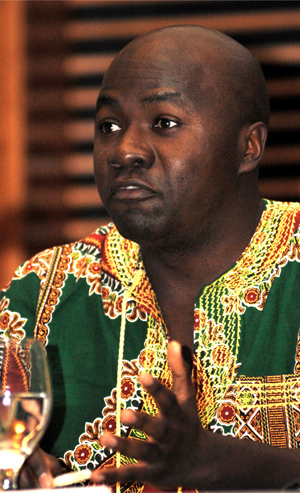
A WITNESS TO GENOCIDE:
Yared Fubusa, a USU doctoral student from Tanzania,
said genocide such as he saw in Rwanda is "personal."
/ Photo by Patrick Oden
By Jen Beasley
January 24, 2007 | What is the recipe for genocide?
In Sudan, the largest country in Africa, hundreds
of thousands of people have been murdered or raped since
2003 in a conflict raging between groups generally labeled
as pastoral Arabs and agricultural Africans.
But according to a panel discussion Tuesday night at
Utah State University, the violence cannot be attributed
solely to land, religion or race. It is genocide in
shades of gray.
The panel, sponsored by a group called Aggies for
Africa, was conceived as a way to generate awareness
of the crisis in the Darfur region of western Sudan.
The conflict has left as many as 400,000 people dead
and 2 million more displaced, according to literature
passed out from the Committee on Conscience. And though
one of the main goals outlined for the discussion was
to get to the root of the issues, the four-member panel
was more able to outline what the conflict is not, than
what it is.
Dr. Peter Mentzel, a panelist who is an expert on
the Middle East and Islam, emphasized that the violence,
which has sometimes been painted as a religious conflict,
cannot be categorized that way.
"One thing I think we can rule out pretty definitely
is that this is not about Islam," Mentzel said. "All
the people involved in this conflict are Muslim."
Though the root causes of the horror may not be easily
grasped, what is clear is that a militia comprised of
Arab nomadic herders known as the Janjaweed has been
systematically slaughtering African farmers and villagers,
possibly with the financial support of the Sudanese
government. A slideshow presented at the beginning of
the discussion illustrated the devastating brutality
in Darfur with graphic photos of mass graves, children
with deep machete wounds, burning village buildings,
and menacing, armed men.
The United Nations has not officially declared the
conflict a genocide, but it has been acknowledged as
such by several nations, including the United States.
Panelist Dr. Chris Conte, an associate professor of
history who specializes in Africa, said the use of terms
"Arab" and "African" confuses the issues. He said many
of the "Arabs" are as dark-skinned as the "Africans,"
and that the term has more to do with political affiliation
with policy-makers in Khartoum, the capital of Sudan,
than with race.
"Everyone in Darfur is dark-complected and speaks
some dialect of Arabic," he said. "Being an Arab has
something to do with being legitimate vis a vis
the state in Sudan."
"What is interesting is the way those terms have become
ethnic markers instead of socio-economic ones," Conte
said.
Conte cited a variety of potential sources for the
conflict. Drought in Sudan has expanded grazing areas
into formerly agricultural regions, generating confrontation
between the groups. The withdrawal of British colonial
influence in the 1950s left north and south Sudan divided
between the Arabs and Africans, respectively, with the
seat of state in Khartoum in the north, resulting in
the political marginalization of Darfur.
"It's very complex," Conte said.
The repeated intellectualizing of the conflict as
complex, however, seemed to frustrate panelist Yared
Fubusa, a native of Tanzania who is getting his PhD
in natural resources. After witnessing genocide in Rwanda,
which neighbors Tanzania, Fubusa said the memory of
genocide is "personal."
"I think this is a language of excuse. It's not complex;
you need about two or three thousand soldiers," Fubusa
said. "Sometimes you just wonder: if Darfur was in Europe,
what would have been the response of the international
community? I think too little is being done. People
are being killed as we speak."
Conte cited the role of the Nile, which flows north
to Egypt from Sudan, as a potential factor in why the
United States has not involved itself. The U.S. may
not wish to alienate its tentative allegiance with Egypt
by doing anything that may interfere with a treaty between
Sudan and Egypt regarding the use of the water. Conte
said it has also been suggested that the U.S. is working
with Sudan on intelligence about Osama bin Laden, and
may therefore be reluctant to make waves with the Sudanese
government.
Fubusa said that the international community has a
responsibility to act.
"I think that the shortcut here, the quickest way
to solve this, is by your American government, by you
pressurizing them," he told the audience. "We have a
saying in Africa, 'America is so powerful, if it sneezes,
the whole world catches fever.' It's up to you to tell
the politicians to stop sneezing."
In terms of what should be done to stop the violence,
panelist Tiffany Ivins Spence agreed that the answer
lies in political pressure. Spence, a PhD candidate
in instructional technology who has done extensive humanitarian
work in Africa, said that writing letters to Congress
would at least get the issue on the table and in the
limelight. She said letters should encourage peace talks,
and support the African Union, which has deployed about
9,000 soldiers in an attempt to stabilize the region.
"If I want to know how strong a nation is, I want
to know how involved their youth is in what's going
on," Spence said.
Christopher Brown, a junior majoring in anthropology
and sociology, said he came to the panel discussion
to become more informed.
"I know that there's terrible stuff going on in Sudan,
but I don't know details," he said. "I thought it'd
be a good thing to come to."
After hearing the discussion, Brown said he might
join the student organizations and continue to inform
himself.
Tiffany Gourley, the treasurer of Aggies for Africa,
said about 220 people came to the discussion in the
TSC Ballroom.
"It's beyond any of my expectations," she said. "It
went so well. We had 100 chairs set up at the beginning
and we had to double that, and there were people standing
in the back."
Aggies for Africa was founded in October as a combined
effort of the Utah State chapter of Amnesty International,
and STAND, which is a non-acronym for "A Student Anti-Genocide
Coalition," by students who wanted to do what they could
to help solve the problems in Darfur.
T-shirts were sold at the event for $10, the proceeds
of which will be earmarked for an organization to help
the crisis. It has not yet been determined what organization
would get the money, Gourley said, because they were
still trying to find one that would not charge administrative
fees.
Anyone interested in helping is encouraged to attend
the next Aggies for Africa meeting Jan. 31 at the "Boathouse"
on 600 E. 700 North.
MS
MS |


