| Soldier/journalist
challenges public to question war reporting
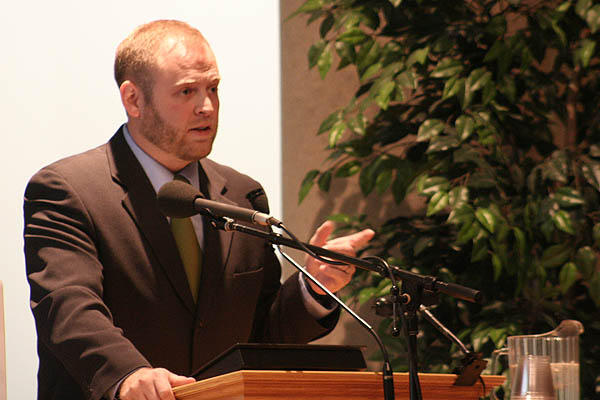
NOT AFRAID OF TROUBLE:
"I got in massive amounts of trouble because I was always
trying to tell the truth," Marshall Thompson tells
a USU crowd. His Media & Society Lecture was sponsored
by the department of journalism and communication. /
Photo by Gideon Oakes
•
Thompson recalls his long and winding road to standing
up for truth and peace
By Dave Archer
January 31, 2007 | Truth in war reporting, or the lack
thereof, was the central theme of Army Reserve Sgt.
Marshall Thompson's lecture Tuesday at the Eccles Conference
Center.
The 2003 Utah State graduate and soldier/journalist
spent a year in Iraq covering the war for the military
and saw firsthand how officials attempted to regulate
what information was passed to the American public through
the media.
According to Thompson, there is a general feeling
that the military holds an attitude of "if journalists
come to Iraq, they're going to write what we tell them
to."
Thompson completely opposes that sentiment.
"I've always seen myself as being completely biased
. . . toward the truth," Thompson said. "I got in massive
amounts of trouble because I was always trying to tell
the truth."
Unfortunately, the truth is something that Thompson
feels is often distorted or hidden before it can reach
the eyes and ears of the American public. Power trips,
cover-ups, policy regulations and a general contempt
for the media are just some of the rationales Thompson
listed for military censorship of the media.
"You show up with a camera, and a lot of soldiers
are predisposed to be mad at you,"? he said. "(Censorship)
happens quite a bit in combat zones."
There are instances, however, where Thompson feels
that military censorship is necessary. Preserving the
security of soldiers and others, for example, should
outweigh the rights of the press.
"Would you rather see someone die, or would you rather
know the truth?"?Thompson asked.
Yet too often Thompson saw military officials abuse
that censorship power, using security as an excuse.
He related one instance where a high-ranking officer
called him a "murderer" for having printed a photo that
showed the face of an Iraqi soldier. The soldier was
apparently killed by rebels who opposed the army after
his identity was revealed through the photo. Thompson
and his companions decided that they would no longer
show the faces of Iraqi soldiers to protect their identities.
However, after Thompson further investigated the matter,
he learned the soldier never appeared in the newspaper
that Thompson worked for, nor in any other publications
around the area. In his opinion, the officer merely
sought an excuse to censor media coverage.
"Too often in a combat zone, security is used to censor
when it actually isn't a security issue," Thompson said.
Cover-ups of events that would be "embarrassing" to
either the military or U.S. allies are also a regular
occurrence. He noted the Haditha massacre in 2005, where
a number of Iraqi civilians, including women and children,
were killed by Marines in retaliation for an insurgent
attack earlier that day.
"This was covered up for months because nobody wanted
to get in trouble for it," Thompson said.
He also noted an instance where soldiers who were
performing a mortar exercise targeted a house and accidentally
fired a live mortar shell, destroying the house completely.
No investigation was done, and it was unknown whether
civilians had died in the accident, he said.
"Just imagine what you are not being told, what will
never surface," he said.
While understanding the need for discretion when reporting
war time events, Marshall says that he is always in
favor of the truth.
"I hope I've got you thinking about the role of censorship
and when it's necessary and when it's not,"??he told
audience members. "I would hope that we would err on
the side of truth, because truth is the only hope for
countries like Iraq and countries like our own."
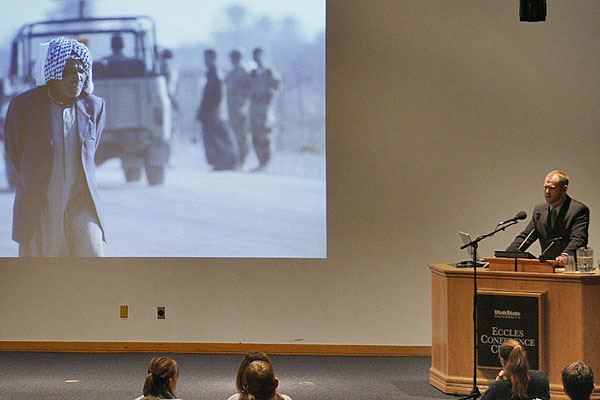
Marshall Thompson shows an election-day slide from
his yearlong service in Iraq. It was not widely reported
that Iraqi soldiers guarding the polls, seen in the
background, could not vote. / Photo by Gideon Oakes
MS
MS |


