|
By Jason A. Givens
July 12, 2006 | If you have a few days to kill
this summer and are looking for a road trip, Mesa
Verde National Park can be an interesting and
educational experience.
Mesa Verde National Park is in southwestern Colorado
in the Four Corners area. From Logan it is about
a seven-hour drive. You drive through Moab so
if you want, you can stop off at Arches National
Park and see that arch on the Utah license plate
(Delicate Arch) along with many other famous and
breathtaking natural arches.
There are some trails to hike and some wildlife
to be seen, but Mesa Verde is most famous for
its cliff dwellings. According to Mesa
Verde's Web site, there are more than 4,000
known archaeological sites within the park, 600
of which are cliff dwellings and many of which
have not been excavated.
The area was inhabited beginning in about the
sixth century with most of the cliff dwellings
being built from the late 1190s to the late 1270s.
You may have heard of the people referred to as
the Anasazi. However, according to Wikipedia,
there is still some debate over what to call them,
since Anasazi is a Navajo term meaning "ancient
enemies." The more preferred or politically
correct terms for this group of people seem to
be Ancient Puebloans or Ancient Pueblo people.
They are believed to be the ancestors of modern
Pueblo peoples, some of whom are the Hopi, Acoma,
Taos and Zuni.
According to Mesa Verde's Web site, the people
who built the dwellings of Mesa Verde farmed corn,
beans and squash on the mesas above the alcove-like
cliffs in which they lived. They also hunted deer,
bighorn sheep, rabbits, squirrels and other animals.
They domesticated turkeys, which they used as
a source of food, and used the feathers in making
clothing and blankets. Other sources of food included
juniper berries and pine nuts.
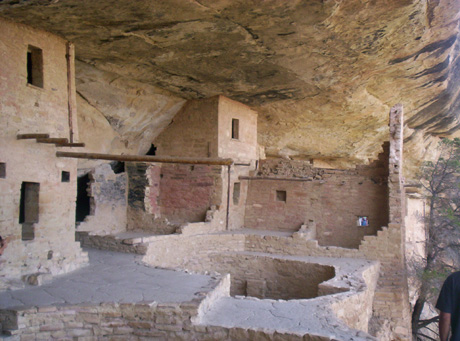
One of the dwellings you can tour is Balcony
House. It is suggested by some archaeologists
that Balcony House may have been used as a defensive
location and was likely one of the last locations
occupied by the Ancestral Puebloans. To enter
balcony house you must climb a 32-foot-tall wooden
ladder and to exit you must crawl through a narrow
tunnelabout 12 feet long. It can be a tight squeeze
for large people; you can find a virtual tunnel
at the visitors center to see if you can fit.
The difficult means of access is one of the reasons
why it is believed to have been used as a defensive
location.
Cliff Palace is the largest of the dwellings
in the park, and is also thought to be the largest
in North America, it is estimated that somewhere
between 100 and 150 people lived at Cliff Palace.
According to Wikipedia, 220 rooms have been identified
along with 23 kivas. The kivas are round subterranean
structures which were used for religious and other
communal purposes.
It is uncertain why Mesa Verde was abandoned,
no evidence has been found to suggest violence.
Evidence of violence has been found at other sites
within the area which has led some archaeologists
to speculate that they may have been aware of
this violence as they were active traders with
other groups in the region. An extensive drought
which caused food supplies to dwindle is another
theory of why the people migrated away from the
area.
This year marks 100 years since Mesa Verde was
made a national park by Teddy Roosevelt on June
29, 1906. Since this year is the centennial they
are celebrating by hosting many special events,
one such event took place May 23 when first lady
Laura Bush visited the park and gave a speech.
To enter the park costs $10 per vehicle. There
is a $3 per person per dwelling fee to tour Cliff
Palace, Balcony House and Long House. Self-guided
tours of Spruce Tree House and Step House are
offered at no charge. One of the park rangers
said they require guided tours as a way to help
protect and preserve the delicate dwellings. If
the size of the groups was not controlled and
if some of the people themselves were left unsupervised
the dwellings could not remain as well preserved
as they are at this time, the ranger said.
Aside from being a national park Mesa Verde is
also listed as a United Nations Educational, Scientific
and Cultural Organization (UNESCO)
World Cultural Heritage Site.
MS
MS |

The author squeezes through the narrow gap at
Balcony House. / Photo by Tatjana Givens

A group of Hopi children from Arizona perform
a traditional dance in Cortez, Colo., on July
2. / Photo by Jason A. Givens above, and all
below

The dancers pose outside a traditional dwelling.

The long ladder.

|