Idaho
dairy producer battles U.S. military
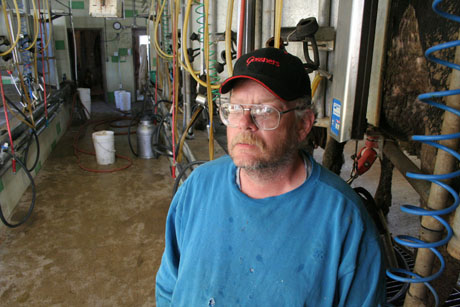
MILK FOR SOLDIERS:
Steve Cann wants Idaho and Utah milk to go to
Iraq. / Photo by Rod Boam
By Rodney D. Boam
March 21, 2008 | FRANKLIN COUNTY, Idaho -- Steve Cann,
a determined Franklin County dairyman, is waging a war
against the U.S. military. Cann wants the milk he and
other Idaho and Utah dairies produce to be available
to the soldiers involved in Operation Freedom.
Steve's son Benjamin was an Army Medic for the 327
infantry battalion, where he served two tours of duty
in Iraq.
"If my son is good enough to go to Iraq, shouldn't
my milk be good enough to go also?" Cann asked.
Cann, a Fallon, Nev., native came to Franklin County,
Idaho, in 1990. He was herdsman for an area dairy since
1998. Three years ago he bought his own dairy. From
early on he contracted with Gossners to buy his milk.
"Dolores Wheeler (the current president of the dairy
company and daughter of founder Edwin Gossner) picked
us up, even though she didn't have to. She does a lot
for the farmers she contracts with. If we could get
the U.S. military to buy Gossners milk, it would be
a boon to Gossners and also this area," Cann said.
"Every dollar spent in this community will be spent
seven more times. Think about that," Cann said.
The company, most known for its cheeses, buys about
45 percent of its milk from small dairies in Southern
Idaho and Northern Utah, said Kelly Luthi, Gossners
aseptic general manger.
In 1982, Edwin Gossner began working on producing
a fluid milk product that utilized Ultra High Temperature
(U.H.T.) packaging technology. U.H.T. Is grade A milk
fluid milk that has been specially processed and packaged
so no refrigeration is required until the package is
opened. The milk is heated to 282 degrees and held for
several seconds, then cooled at 70 degrees in a continuous
pressurized system. The next step is packaging the milk
aseptically in special containers. The elevated temperature
kills harmful bacteria that cause milk to sour or spoil
for longer periods of time.
The company, headquartered in Logan, Utah, has a sister
plant in Burley. Gossners decided to pursue the UHT
milk market instead of Grade A milk, allowing them to
open up new marketing avenues. Gossner UHT Milk can
be kept unrefrigerated at room temperature for months
and is an asset to the military community. Today, Gossner
Milk is sold on military bases in Puerto Rico, Panama
and as far away as Korea where milk supplies and refrigeration
is limited.
Although, the product is used on some military installations,
it is not available in Iraq to the 137,709 active duty
soldiers and 23,000 military support personnel and in
Afghanistan with nearly 21,000 active military personnel
and 5,667 National Guard and Reserves. Americans in
the Middle East overseas are currently drinking reconstituted
or powdered the majority of the milk is comes out of
Kuwait. There is a small amount coming from a dairy
in Bahrain as well.
The Defense Department performed a taste test, and
their results showed the Saudi milk was preferred by
the test body of less than 30 people on the panel. The
Department also squawked about the $2 million per year
cost in shipping the boxed milk to the Middle East.
Cann dogged and pulled the ear of every government
official and age ncy he could think of by letter and
by phone trying to get some action.
"Some of them acted like I didn't have the right to
question them about anything. One of them told me I
was rude, some treated us like a red-headed stepchild.
They should be working for us, and if they don't, we
shouldn't reelect them," Cann said.
Idaho Sen. Larry Craig and Sen. David Vitter from
Louisiana took up the cause and asked the Defense Department
to do a more comprehensive test. They claimed the test
with such a small focus group couldn't speak for the
nearly 190,000 Americans serving in Iraq. Included in
the letter was a reference to a conference sponsored
by the Defense Supply Center in Philadelphia in July
of 2006 where producers of U.S. goods and services were
recruited to participate in a conference themed "To
Strengthen the Domestic Industrial Base for U.S. Military
Suppliers."
Their request was rejected.
Shortly after the statesmen started to get involved
in the milk matter, Craig's credibility suffered for
toe-tapping incident in a Minnesota airport, and Vitter's
suffered when suddenly the senator was listed on the
rolls of a Louisiana brothel.
"Those two people were the only two that took up our
cause, both go t their wings clipped and both are good
men. I could care less about the sexuality," Cann said.
Despite the results of the official taste test, families
of soldier s are buying the product and sending it over
at their own expense, some at the request of soldiers
serving there.
"People are buying cases of our milk rejected by the
military taste testers and sending it to soldiers in
the Middle East because the they don't like the Saudi
milk they are being served," Gossners' Luthi said.
Luthi has letters and cards from soldiers thanking
them for the milk and telling them how much better the
Cache Valley product is than the Saudi liquid they are
being served by the military.
"Before the Iraq war, or whatever they call it, started,
we were sending the military about four truckloads a
week. Since then we have been sending them two trucks
a week. If we could get the contract to the Middle East,
we would be sending eight to 10 truck loads a week,"
Luthi said.
The Gossners executive said, "If they had a reason
other than the t aste test and shipping cost, we could
accept it. If they thought they needed to procure Saudi
milk because it was building good relations, we could
accept that. But failing a taste test?"
Despite his setbacks, Cann, for the most part acting
alone, continues to push forward to get someone to recognize
his cause, to get Cache Valley milk to people fighting
half a world away.
"I want the best milk sent to Iraq, don't you? Buy
American! That's what it's all about," Cann said.
MS
MS |