|
Hyde Park's Helen Seamons recalls
simple joys, self-sufficiency -- and roller-skating
to Smithfield
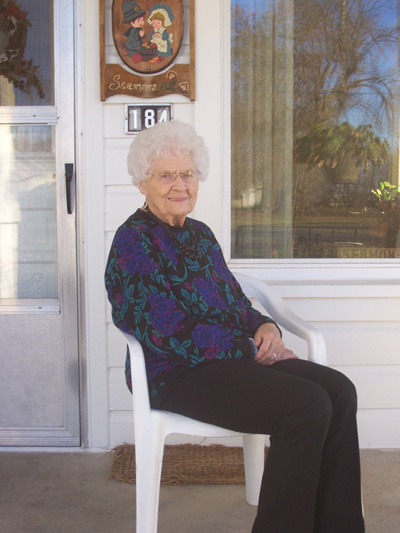
Helen Seamons / Photo by Brittny
Goodsell Jones
By Brittny
Goodsell Jones
November 16, 2008 | HYDE PARK -- When Helen Seamons
was in junior high, she and a girlfriend roller-skated
more than three miles from Hyde Park to Smithfield down
the US-91 highway, just because they could.
Today, Seamons said there are too many cars to attempt
the same journey. But in the 1920s, that wasn't a problem.
"If you saw a car, you about knew who it was," the
Hyde Park resident said.
Seamons is one of Hyde Park's oldest residents. She
will turn 94 next August. The house she currently lives
in (going on 64 years) is just a few blocks away from
the house she was born in. Seamons has lived most of
her life in Hyde Park except for a few years of living
in Benson after she got married.
Having lived for almost a century in Hyde Park, Seamons
has noticed a few changes around town. The most obvious
change is growth, which resonates back to her story
about roller-skating -- everyone knew everybody on the
road back then, she said. Now, roads are too busy.
She doesn't mind the presence of new houses or even
the number of people, but she misses the feel of a close-knit
community that comes from a small town.
A member of The Church of Jesus Christ of Latter-day
Saints, she compares the change by looking at the difference
in the number of LDS wards -- the neighborhood boundaries
that determine what religious congregation an LDS member
is a part of -- in Hyde Park. Back in 1933 while Seamons
attended North Cache High School, only one ward existed
in Hyde Park. Now, there are more than nine wards. Being
a member of her LDS ward is one way she can find a tight-knit
community feel.
Along with busy roads came more businesses and retail
stores in the valley. Fashion is something Seamons said
has changed. She remembers a day of dressing in her
best clothes to attend dances in Hyde Park -- she still
has her eighth-grade graduation dress somewhere. Dresses
were worn all the time while growing up. In general,
women didn't wear pants.
"They weren't heard of," she said.
Seamons, whose husband passed away in 2002, has four
children, 20 grandchildren, 57 great-grandchildren and
two great-great-grandchildren.
"I've been trying to make a Christmas list of their
names but I can't remember all of them," she said with
a laugh.
Besides the size of her family, others things such
as entertainment have changed. During the 1930s, Seamons
said she and her friends made their own kind of entertainment.
Roller-skating in her church's cultural hall was popular.
Movies were also big. She remembers watching Gone
With the Winda few times in Logan theaters.
When her friends wanted to go to Logan, they often
took the street car that ran from Preston to Logan.
These outings weren't typical since it was more convenient
to stay in Hyde Park. On nights in Hyde Park, it was
common to get together with girlfriends for candy pulls,
an activity where each girl would bring an ingredient
to make candy such as taffy or divinity.
"It was mostly girls but boys would come around and
try to swipe it," she said.
One of the first television sets in Hyde Park was
owned by Seamons' family. She remembers neighbors dropping
by their house for Friday Night Fight Nights, which
featured boxing matches on television.
Even having a car was considered a nice luxury. For
many years, Seamons said her dad didn't own a car. She
also shared one bicycle and one sleigh in between her
five sisters.
The volume of items people own now is a major difference
she sees in today's culture. Now, every kid has a car,
she said. Overspending and indulgence has much to do
with the massive credit card debt the country is currently
facing. Many kids today are spoiled, Seamons said, and
tend to buy everything they want even if they don't
need it.
Her parents taught her to buy what was necessary,
and do the best she could at the most reasonable time
and price. Her modest house was paid off more than 40
years ago. At the time, her monthly house payment was
$50. She remembers when a loaf of bread sold for 10
cents. And during World War 11, Seamons remembers being
gas- and sugar-rationed.
During the Great Depression, Seamons said her family
didn't feel the effects as strongly as others did. Her
mom sewed most of the clothes anyway and there was always
enough to eat because of their garden.
More than 70 years later, Seamons also remember the
impact President Franklin D. Roosevelt had on Americans
during the Great Depression.
"He brought modern times around and got things going,"
she said. "It's been said that we need another FDR with
conditions turning up like they have. It's a really
scary time."
Even in these somewhat discouraging times, Seamons
thinks having a good head on your shoulders will help.
Having lived 93 years, Seamons said her advice to others
is to always do your best and be honest in your dealings:
"Keep the commandments and love one another."
NW
MS
|