|
How to frame a picture so you'll
still like it tomorrow
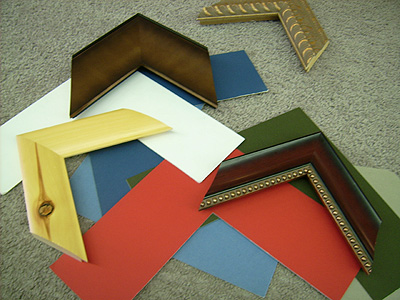
Photo illustration by Alice Bailey
By Alice
Bailey
May 5, 2009 | The artwork you display in your home
can have a big influence on the atmosphere within your
household and make your home your own. How you display
this artwork is also very important. Framing can be
an expensive process, so you want to make the right
decision the first time. Picking the right frame is
important and can take some time, so here are a few
tips on getting it right the first time.
The first thing you want to take into consideration
when picking a frame is the size of the picture. A bigger
frame always looks better on bigger pictures, and a
thin frame will not usually be able to support the weight
the mounted picture and the glass. If the frame is too
small, then the secures in the corners will come undone
and the bottom of your frame will fall off. The exception
to this rule would be that of a metal frame, which can
usually support more weight than the average wood frame.
The subject of the picture is also important when
picking a frame size. Kevin Chugg at Al's Trophies gave
the example of the subject of the picture being a predominantly
large apple. In this case you can pick a large frame
and a wide mat, even if the overall size of the picture
isn't very large. If the subject of the picture is small,
too much frame and mat can distract from the actual
picture.
Another way to accent small subjects would be to pick
a frame with small details, which amplifies the style
of the picture you are framing.
If your picture is big you also might consider mounting
it. Mounting your picture will keep it from buckling
in the frame over time, and will keep it flat. The larger
the picture, the more likely it is that it will buckle.
If your picture is wrinkled or has dents in it, mounting
can help alleviate the appearance of these flaws. As
a general rule though, you won't usually want to mount
an original piece of artwork or a limited edition print.
You can also get a protective UV spray on your mounted
print if you don't want to get glass. This will make
your picture lighter and prevent the glare that glass
produces. If you choose to not get glass on your picture,
you can also get a finish on your print which will make
it look like it is printed on a canvas or linen.
If you choose to spray your picture instead of putting
glass on it, don't put a mat on it. Mats need the protection
of the glass and will usually warp and discolor otherwise.
Depending on the subject of your picture and the room
you are going to be hanging it in, you will want a different
style of frame. If your picture has a rustic subject
you will probably want to avoid ornate of modern frames,
and choose instead a simple wood finish. The typical
choice for classic style paintings would be a gold frame,
and modern art usually is framed in something plain
and black.
Don't plan on matting paintings, especially oils.
Because mats need glass, and paintings don't, it's usually
better to put just a frame on your painting, unless
it is a watercolor. If it is an oil painting, the oils
will seep into the mats and discolor them.
If you are picking a mat, the mat you pick should
usually be fairly neutral and match one of the predominant
colors in the picture. If it is an original piece of
art, cream-colored or white mats are a more correct
choice. Black is also an appropriate choice of mat color
for original art, depending on the subject.
If you want to highlight a brightly colored point
of interest in the picture, you may want to choose a
double mat with the undermat being the same color as
the subject you wish to highlight. Generally though,
you don't want the predominant mat color to be that
bright color or it will distract from the picture instead
of highlighting it.
The glass you choose depends on where you're going
to be hanging the picture you're framing. If the picture
will be getting a lot of direct sunlight then you will
probably want to select something with a UV protection
factor. If glare is going to be an issue, then you're
probably going to want a non-glare glass. If glare is
going to be a problem and you don't like the foggy surface
of non-glare glass, you can buy museum glass, which
is much more expensive but has a crisp look and doesn't
reflect. In most cases, regular glass is just fine.
For those of you who would like to make your own picture
frame check out this site
where you can learn how to build your own wooden picture
frames to fit any size picture.
NW
MS
|


