|
Hyrum's city museum steps you
back to times past
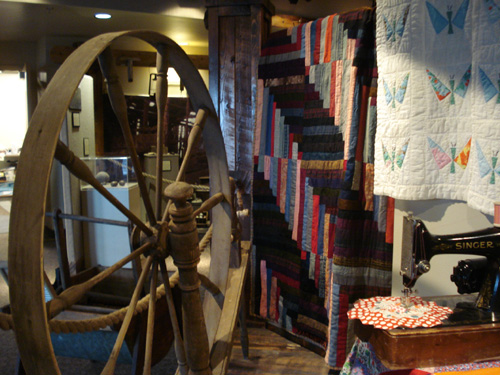
WALKING WHEEL:
Museum displays old-time equipment. / Photos by
Caresa Alexander
|
By Caresa
Alexander
May 5, 2009 | HYRUM -- When Matt McBride was
younger he would visit his grandparents in Hyrum.
He helped his grandfather build a fort. Cutting
pieces of wood and putting them together became
a part of his summer and also a tie he shared
with his grandfather. Now, as docent, or museum
lecturer and guide, Matt hopes to help those who
visit the museum feel connected with the past
and have their own ties to history.
Matt's father, Jeff McBride, is the director
of the Hyrum museum.
"The artifacts are only as good as the
stories they tell. That is what they are there
for. You take things and you try to connect people
and places with those things," said Jeff.
"Sometimes the fun is not just the item
itself, it's finding out the stories and the research
behind it," said Matt. The stories behind
some of those items are amazing and very personal
to those that visit.
|
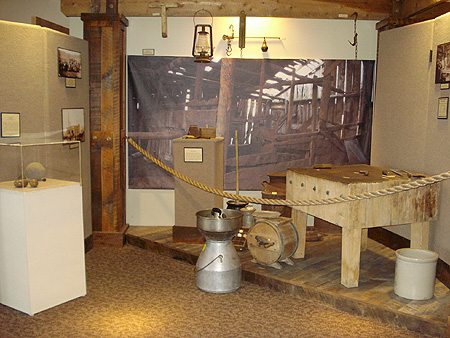
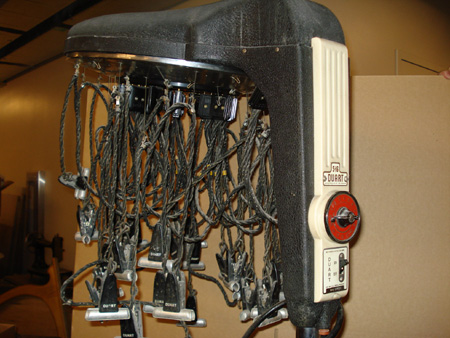
ANTIQUES: An agricultural
display, above, and a home perm kit.
|
One of the stories revolves around a Philco radio.
As one walks into the Hyrum museum, to the right is
an old push-button radio. This feature made it the No.
1 selling radio in 1941. Some of those AM stations that
were programmed in Nebraska are still in existence.
When Matt switched on the radio it came to life as Dinah
Washington sang Gershwin's, Our Love Is Here To
Stay.
Matt explained that the radio was more than a radio.
There was a story behind it, as there is with every
item in the museum.
"All of a sudden it becomes something real and it's
cross-generational," Matt said. "If I have a grandparent
who is saying ‘my favorite radio program was this' or
‘my parents used to listen to this' and they have their
children or their grandchildren here, then it becomes
more important to them and that's one of the things
that I would hope that any museum does. That it ties
the past with the present and at the same time it puts
the present in looking forward to the future because
those things are important."
In a glass case opposite the tiger wood radio is a
butter mold. The square wood box with lid doesn't look
like much. To some it is just a butter mold, but to
others it means much more.
One lady that came into the museum remembered making
butter with her grandmother. She told Matt that it was
during the depression and her grandmother made butter
to sell to the neighbors as a source of income. The
lady went from being a kid to a teenager doing those
things. The butter mold was a way of connecting to her
grandmother.
It's not only the older generation that enjoys the
library. Jeff recalled a kindergarten class that visited
the museum. There were about 40 children and the staff
wondered what to do with the 5-year-olds. It was decided
to focus on ropes. The children held hands and made
a human rope as they walked around the museum. The children
were asked to remember one item they saw and it was
later discussed. Jeff said a couple of those children
came back with their families. One girl returned with
her mom and brothers. The girl told Jeff she wanted
to show her family around the museum.
"She reached up and wanted to hold hands because she
said ‘we make a human rope, that is how we see the museum,"
said Jeff.
Barbara McBride, Jeff's wife, made up a tour in which
she discussed the work of women to a group of 8- and
9-year-old girls. She helped them recognize the important
work of the pioneer women and the work women do today.
"We talked about how frugal these people were with
maybe two dresses to their name and one pair of shoes.
How different it is from our lives now. This is the
part that is applicable. If we don't have any idea of
the contrasts then it doesn't mean much to us," said
Barbara.
Back then girls were not supposed to help in the garden
or do wood working. Barbara explained that it was different
then than it is today. She told the group of girls they
could do any job they wanted if they had an interest.
That is what the museum and workers do is help one
understand the growth not only of the valley but of
the people in the valley. Not all items are serious
in nature. Some are funny.
Matt said that children remember the bezoars, or hairballs,
on display. Not all hairballs come from cats. The bezoars
at the Hyrum museum came from cows. A massive grey,
round ball that looks like a rock sits in the case next
to four smaller bezoars. In the same case are two cuds
that look like shiny, specked, light brown rocks.
Most people remember the name bezoar from the Harry
Potter series but something most people don't know about
is National Hairball Awareness Day. This was April 27.
Matt said school groups and scouts love the bezoars.
From there Matt will talk about other things that come
from cows, and move onto other themes.
There are about 13 themes around the museum. Jeff said
they are working on collecting personal and oral histories
for those topics. By Veterans Day he hopes to have interviewed
veterans of World War II, the Korean War and the Vietnam
War.
"We just have a little different perspective on things
that are fairly unique and people will have a new experience
when they come here from one year to the next or even
in a few months," said Jeff. The museum has changed
since it first began with his dad.
The first museum in Hyrum began around 1980. Jeff's
dad ran the museum and solicited donations and loans
for the museum. The museum operated in the basement
of an old church for about 10 years. The museum then
changed ownership and moved to the basement of the city
offices. There was a geological collection that was
on loan so much of the focus of the museum was on geology.
Between the years 2005 and 2006 the museum was closed
a lot of the time due to health problems with the owners.
In November of 2007, Jeff and Barbara were asked to
be on the board of the museum. Plans for a new library
and museum were already in the works. Jeff contracted
with the city to operate the museum. The grand opening
and reception was May 23, 2008.
"We just started over here like it was a new museum.
Not just an old museum moving over here," said Jeff.
"We determined that it was in the best interest of the
city and community to make it a historical museum. That
is what we've tried to do is capture the history," he
said.
The new museum has seen about 200 to 300 visitors
a month. Matt said he would love more people to visit
the museum. Barbara said she would like the senior citizens
to visit because there is stuff they probably used that
is on display.
"There is so much here and people that come in here
are surprised," said Barbara. "This needs to be treasured,
or it just becomes a place where there is just stuff.
If it doesn't change, if it just stays static, people
have no reason to come back. That is the reason we change.
One interesting item that is stored in the back room
of the museum is the Loving Cup that the Hyrum Community
won in 1927. According to the book Home in the Hills
of Bridger Land: The History of Hyrum from 1860-1969,
this award was given to a rural community in each state
that contributed to the happiness, comfort and well-being
of its people.
The museum continues that same tradition today as
does the McBride family. They are dedicated to serving
the community and helping people find ties to the past
because that is what is important.
NW
MS
|


